Wednesday, April 8, 2009

Herding Cattle and more

Remember to click on pictures to enlarge.

There have been many things happening these past few days. As I reported earlier, we have three Baseline Surveys or needs assessments going on almost simultaneously. There are needs in three parts of the area – in Athi River, in Kijiado and in Kangundo.

First of all, here in Athi River we are asking the question: Does your family have need of a Children’s Home where your child can get adequate care and food? This is a difficult question because although there is an obvious need for assistance, if a child goes to a boarding situation, then there is a loss of a worker to care for goats, cows, etc. So my guess is that there will only be a few.

In Kangundo, we went looking for orphans or those who, although they have one or two parents, are not cared for or fed. This is the town where we have been given use of a house for a Children’s Home. There were more children than we anticipated. There are many children whose fathers are dead or gone, some who are double orphans living with relatives or on the streets. We have collected forms on over fifty and have a list of twenty more who are extremely needy.

In Kijiado, word got out that there may be a preschool and food program for early childhood education. Over 60 adults and 70 children showed up at a make-shift church waiting for those who were coming to do the survey! Hundreds came in hopes of a new preschool!
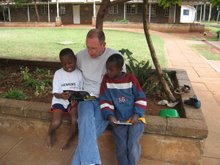
These are all Maasai and walked from long distances to get to the top of the hill where the church was located and on which ground we would start the ECDE Center. We were surprised at the interest knowing that education has traditionally not been a priority for the Maasai. The pictures are heart-warming but the high expectations are daunting.

We now look to input the data and make some decisions that always center on finances.

On Tuesday I took the long-awaited journey with the herds and the Maasai. I went with my young friend Fred. The point was to have the experience of herding but mostly to get a full day to ask questions of Fred and the other Maasai with us. We walked from 7:30am until around noon. At that time Fred and I left the herd and headed back home via a tall hill and through some barren landscape. As we walked and talked we came upon a large herd of wildebeest. There may have been a hundred. Then we came to some zebras grazing under some trees and some antelope. Finally we traveled towards about a dozen giraffe we spotted in the distance. I felt like I was on a movie set or in the Garden of Eden. It was a wonderful experience, although my legs ache terribly this morning. We walked for almost a solid 8 hours – stopping only to drink water and eat chapatti we had brought with us. We talked about religion, politics, Maasai culture, initiation rites of passage, and circumcision. Polygamy, education, tribal wars were also discussed. Of course there were plenty of questions about life in the USA as well. Fred is a good guy, wise beyond his 18-20 years. He doesn’t know when he was born. He has older siblings and many “step” brothers and sisters. We are “lending” him a small amount of money for college classes in social work and project organizing. He is to repay us when the rains come and the cattle are saleable. Now my only other wish yet to be fulfilled is to stay in the Maasai manyatta. Fred says his mother is almost finished building a new house. Houses are made of sticks, mud and cow dung and need to be rebuilt quite often. Anyway, her house is almost complete and I am invited to stay there, if I promise to bring my iPod. It has been a great few days for which I am grateful. Alleluia.

I go to Nyumbani Village to see the children tomorrow. I can’t wait and have talked to some of the children by phone already. They are back from high school for the Easter break. The matatus hike up the prices on holidays and I was told I would probably be stranded in Machakos if I board a matatu from Athi River to Machakos and then on to the Village. A better solution is to go all the way into Nairobi and then board an “express” matatu to Kitui and the village. At Christmas I paid 600 shillings for a ride that usually costs 400. I assume the same for Easter. I’ll stay in the Village for a few nights and play it by ear as far as when to return to Athi. Mwololo is going to Machakos, his rural home. I may link up with him over the weekend and stay there for Easter. I am just not sure. Peace.

Wednesday, April 1, 2009

Kajiado Famine - It's Everywhere

Below is an article about Kajiado, the town where we would lke to do some programming. We traveled there a week ago towards Namanga. The drought has worsened an already difficult life. Many children are not going to school and are instead looking for food and money to buy food. Here is this morning's article entitled "Land of the Dying". We are sending a social worker and a masai interpreter to initiate a baseline survey to see what services we can offer, if any.
By DAVE OPIYO April 1 2009 at 21:17

The stench of cattle carcasses left to rot in the bushes is unbearable. Flies buzz around the carcasses, occasionally landing and feasting on the remains as dogs watch from a distance. They have seemingly refused to fill their stomachs with the free food. It is midday and the sun is quite hot. Just a few metres away, a young Maasai moran is driving a herd of about 50 emaciated cows home from the watering hole, oblivious of the foul smell. The day has not been good for him. Despite waking up very early in the morning, his animals have not had enough water to drink and food to eat. This is now a normal happening.
But even as we struggled hard to stifle the awful stench by covering our noses with andkerchiefs, Mr Mutungi Lesingo, a resident of the Kajiado Central constituency, Rift Valley province, who is in our company, looks disturbed. We are about 160 kilometres from Nairobi on the road to Namanga, the town on the Kenya-Tanzania border. The area is represented in Parliament by Defence assistant minister Joseph Nkaiserry.
Mr Lesingo is sadly witnessing the collapse of his “huge empire” of cattle, which took him years to amass, in a matter of days and there is nothing much he can do to save it. The carcasses strewn all over the area were once part of his large herd of cattle. Today, they belong to flies and scavengers. Mr Lesingo, who has four wives and 12 children, was by last December the proud owner of more than 300 head of cattle – a rich man by any standards. But now, the number of animals in his boma (compound) is less than 150. The drought has taken its toll, not only in Kajiado, but also in the rest of the country.
In the past month alone, Mr Lesingo has lost more than 40 animals. He is not alone. The same story is replicated in other areas. Surprisingly, goats and sheep in the area have not been much affected by the drought as they feed on the shrubs that dot the area. According to Mr Lesingo’s Maasai culture, an individual’s riches are determined by the number of cattle he owns. The more you have, the richer you are.
Mr Lesingo says the failure of the rains has spelt doom for his cattle, which now face the twin problem of lack of pasture and water to drink. “We are in many instances faced with a dilemma – deciding whether to feed ourselves or feed our cattle. I tell you, it’s a situation that many of Kenyans would not like to be in,” he says. It is for this reason that the pastoralist decided to sell some of his livestock hoping to replenish the number in future.
But this has further worsened his problems. No one wants to purchase cattle on the verge of death. And like Mr Lesingo, many pastoralists facing the same predicament have brought their emaciated livestock for sale. Unfortunately, very few people are interested. A cow that normally goes for Sh30,000 ($375.00) is currently being sold at as low as Sh300 ($3.75). And even with this low price, the businessmen still don’t attract buyers. The pastoralist says that despite their predicaments, neither the government nor relief organisations had come to their aid, forcing several of the pastoralist communities to flee to the neighbouring Tanzania in search of pasture for their animals andThey are now appealing to the government to come to their aid, failure of which many will continue suffering from famine.
The weatherman has already sounded a warning that the long rains are bound to delay in some
area, further spelling doom for the residents. In its latest weather outlook for the month of April, Mr Peter Ambenje, an official from the Meteorological department says pasture for livestock will continue to diminish in the pastoral areas due to the expected poor rainfall performance. And he advises the pastoralists to destock and only remain with “strategic stock”.
Further he urges the government to rehabilitate watering points to avoid conflicts and civil insecurity that is likely to emanate from water scarcity. Says Mr Ambenje: “In these areas, there have been a few cases of animals dying following the prolonged dry spell and poor and limited pasture conditions.” He adds: “Some perennial rivers have even dried up due to the huge rainfall deficits for consecutive months".

Saturday, March 28, 2009

Weekend

It is Saturday March 28, 2009. Yesterday I met with the two Early Childhood teachers to go over the curriculum and create some lesson plans fo rthe coming week. Next week is the close of school. The children, even the preschoolers have an exam. The exam was handwritten. My job was to type it, create the pictures, etc. It took me all night but it looks professional, like a phonics book for first grade! These kids are not your usual age for preschool. Some are quite old so a test, although not optimal, is not so far fetched. Today I took a matatu to Kitengela to print the exams and make some copies. Tomorrow I’ll head to church at St. Jude’s, the Catholic Church in Athi River town. Apparently it is because of people not going to church that it has failed to rain for a year! So says Mwololo. So, I’ll go to church to make sure it rains. (By the way, it did shower a little today.) Religion around here is interesting. There is quite a mix of African Christian churches, Muslim mosques and some tribal religions of the masai. Then there is St. Jude Catholic church. As I write, there is a man outside my window, praying the sun down at 7:00pm. The Islamic influence in this area is definitely present. There are Islamic schools, mosques etc. And this young man, on his knees in the driveway, has stopped to complete this Saturday with prayer.

Tomorrow, George is coming to pick me up after church. We’ll spend the afternoon in Kitengela, catching up on things. I called the village in Kitui to ask permission to visit the kids when they are on school break. I’ll probably go next weekend some time. I keep getting “flashed” in the wee hours of the night. Flashing is when someone calls you, lets it ring once and hangs up because they have no money on their phone – no airtime. So they flash you expecting you to call them back on your dime. I am sure it was some of the Village boys who heard I was in town. I didn’t call back. It was too late to start that stuff!

Next Wednesday Mwololo and I should head to Tanzania to visit another program similar to ours. They too are working with the Masai in early childhood and HIV/AIDS awareness. I am not sure where we are going, only that it is across the border. We are also putting together questions to form a baseline survey or assessment of needs at the two locations Kangundo and Kijiado. Mwololo and one Masai will go to each place and begin asking questions and compile some data for possible future programming there. That will probably take place Thursday and Friday. Things are happening quickly but we want to get things going while I am still in Kenya. Once we have a baseline, then we can see if there is a need and any way to find money to do the additional programming.

Thursday, March 26, 2009

We awaken . . .

“We awaken in Christ’s body,
As Christ awakens our bodies
There I look down and my poor hand is Christ.
He enters my foot and is infinitely me.
I move my hand and wonderfully
My hand becomes Christ,
Becomes all of Him.
I move my foot and at once
He appears in a flash of lightning.
Do my words seem blasphemous to you?
Then - open your heart to Him
And let yourself receive the one
Who is opening to you so deeply.
For if we genuinely love Him
We wake up inside Christ’s body
Where all our body all over,
Every most hidden part of it,
Is realized in joy as Him,
And He makes us utterly real.
And everything that is hurt, everything
That seemed to us dark, harsh, shameful,
Maimed, ugly, irreparably damaged
Is in Him transformed.
And in Him, recognized as whole, as lovely,
And radiant in His light,
We awaken as the beloved
In every last part of our body.”

Saint Symeon

The words are consoling and humbling. I read it quite often and smile and try to be open, awake, transformed. I try to be His new creation and allow His love to enter me.

Wednesday, March 25, 2009

Kids from the Classroom!


s

PROJECT UPDATE


Today is Wednesday March 25, 2009. I went with Mwololo to the ECD Center to check on the cook for the porridge. We hired a woman to cook the porridge for the next two weeks to make sure it was done and done correctly. There is a cholera outbreak in Athi River and we need to make sure things are prepared correctly. Here is a report from the Project Director with information on the porridge/feeding program at the preschool.
The 10:00 a.m. porridge at the Early Childhood Center is always enriched and usually a meal in itself. It is enriched with such cereal flour as maize, millet, finger millet, sorghum, soya, green grams, groundnuts, pumpkin seeds and powdered milk.

In one day, the cook uses 1.5 kg if the total number of children present is between 40-45. Sometimes the number shoots to over 50 children and the cook uses 2kg of the mix for porridge preparation. This means that between 8-10kg is used within a week. Though the prices of flour change, the following are average prices.

Maize Flour 210
Millet 195
Finger Millet 235
Sorghum 215
Soya 275
Green grams 235
Ground nuts 315
Pumpkin seeds 600
Milk 580

TOTAL SHILLINGS 2860
X4
MONTHLY 11,440 or $143.00 per month

Sometimes the Director sympathizes with the drought situation and purchases sugar to sweeten the porridge, though not always.

Submitted by Mwololo Kilonzo, Project Director
Note from Ed: Milk and water for the porridge is brought from the Masai houses. Today we witnessed the water being boiled first. The milk is boiled separately at the houses of the children. This precaution is due to a cholera outbreak in Athi River.

I put together a handbook for the teachers with information on the national curriculum and syllabus. It is difficult to understand and often more complicated than it needs to be. Objectives, themes, activities will all be discussed at a meeting tomorrow afternoon. The preschool teachers are not yet trained. That comes soon now, after a probationary period. So as far as training, MWEP is sponsoring training for the Preschool teacher, a young Masai man going to school in social work and an adult education class of maasai of 17. Here is what is going on in other parts of the project, some needs and goals:

Masai projects on site here that need continued or new funding

1.) Continuation of providing school fees, uniforms, books to Masai children. Students attend school off-site. (These are not children attending our Early Childhood Center but who attend 9 local schools.) Their fees are due three times a year and we provide uniforms for 176 students, school fees for 63 students and textbooks for 55 students. These are the most needy of the Masai.
2.) School Feeding Program for approximately 50 preschool students at the Esarunoto (Refuge) Early Childhood Education Center – a Preschool which we have begun and staff with two teachers and a cook. We purchase a healthy porridge mixture and it is prepared for the children by 10 a.m. each day. For some, it is their only meal and a reason to come to school.
3.) Medical Van Visits – This would be a new venture. A medical van and two nurses would visit the manyatta at least once a month, preferably twice a month. The cost is for the van, transport and two nurses from Athi River town.
4.) Adult Education Classes – We did a pilot program for four weeks – three days per week and attracted 17 adults. More adults would be available but because of the extreme drought, many adults are gone with the herds to find green pasture. Costs are for a retired teacher and her transport here – three days per week. The classes would run an additional 5 months with an exam following the course. Classes provide instruction for learning English, Swahili, agriculture and Mathematics.
5.) Youth Activity Days – when school is not in session, we provide organized activities that are fun but also teach about important topics such as HIV/AIDS.
6.) Preschool Uniforms – At first glance I didn’t see need for preschool uniforms but after seeing the lack of clothes in general, the uniforms for our Esarunoto Preschool students will be necessary.
7.) Self Help Activities – Not yet initiated but we need to find sources of revenue from beadwork to help make our initiative sustainable. We would provide start-up materials for beadwork and find venues at which to sell the work.
8.) Purchase water for holding tanks - The school needs water for the feeding program (nutrient filled porridge daily). The best option for us is purchasing two large plastic tanks and having fresh water trucked in monthly. The tanks would be secured at the school.

There are also additional needs such as teacher training, HIV/AIDS sessions for youth and women, personnel costs, and emergency food relief (which cost us almost $4,000 due to the continued drought).

We have also looked at two sites for additional projects – although these are in the initial stages of study. Let me tell you about what we know so far about these two possibilities.

Kangundo – a town about 90 minutes from Nairobi. The area is remote, dry, and predominately Kamba tribe. There is no electricity or decent water. A piece of land with a house on it has been offered to the Program Director for use as a Children’s Home. There is also some land adjacent to be farmed – if it would rain! The needs discussed are two: 1.) A place for Masai children from here at Athi River (that we see daily), ages infant – ten years, who are not being cared for by parents or have no parent. There has been discussion by these parents that they cannot provide for these children and therefore, the children suffer. The house would need to be furnished, food provided, social workers to staff, an educational outlet sought - off site or create something there. 2.) There are also homeless children living on the streets in the nearby town of Tala. These children have either lost their parents or have been abandoned. The tribal affiliation would be Kamba. The specific numbers and needs are not yet known.

Kajiado – a town about two hours from Athi River. Kajiado is the ancestral home of many of the Masai we work with here in Athi River. It has not rained there since last March. It is a dry and barren land. Hence the Masai moved on to Athi, River hoping for better grazing. No luck. Anyway, we traveled to Kajiado with a Masai man who has land there that he would like us to use for programming or for needy children in that area. Perhaps an early childhood center, a feeding program etc. similar to what we have in Athi. We are unsure of numbers and needs until some assessment is completed.

So, that is what’s up in Athi River and other places about now! I go to Nairobi tomorrow to print and copy some materials and make some purchases. I also need to do some food shopping. I think I am paying about $15 per week for food and water. Not too bad

Poverty

Ben came over to visit this weekend. Like many Kenyans, Ben is looking for a job. He has done many things and led an interesting young life. There is a good chance Ben will move to Kibera on Thursday. He has been staying with someone who has found employment in another part of Kenya and Ben can’t stay in that place. So Kibera slum is the place. He has dropped a lot of weight, eats poorly – when he eats. The drought, famine, joblessness is killing Kenyans. I can look at friends I’ve known since the beginning of my time here. They are thin, malnourished and some are homeless now. There are no safety nets like what I would have at home. Relatives are no help since they are in the same shape. When there are rains, there is food – somehow. But there has been no rain – some places for a year or more – no rain. The cattle we saw today at the Masai manyatta were lying down, emaciated. No water, no grass. We met today with the Chairman of the Education Committee we set up to help with school issues. He was waiting for our meeting and then taking his goats to the airport where there is some green grass. The airport is at least an hour away by car. It will take him forever to get to the airport but if he doesn’t do this, his animals will die.

Friday, March 20, 2009

Friday in Kijiado


This morning we left very early for Kijiado. I took a motorbike to Athi River town and met Mwololo. Then it was a matatu to Kitengela. From there, another matatu and about two hours and we were to the town of Kijiado a town you would pass if you were headed for Tanzania or a safari. The roads weren’t as bad as others but tons of construction and dust. Once at Kijiado we met James, a Masai who once lived at the Athi River manyatta but moved his family back to Kijiado, the home of his father. He owns some land he wants to allow us to use for children. Jame’s cattle are now at Tala, a town we were close to yesterday. James, like most Masai men, has three wives and many children. So we met James in town and found a car that would take us to his manyatta. The roads were terrible and the land seemed to get drier and drier as we got to the remote areas. It was about 20 KM from the main town. The land, although dry and dusty, was beautiful. I walked with James up the steep hill of his property, a vantage point where you could see the beautiful landscape. On one hill they built a church of metal sheets and benches. The place was silent but for the winds. From there, far off in the distance, you could see Mt Kilimanjaro, snow covered and majestic. We were nearing the Tanzanian border. At the top of the biggest hill, James apparently said he would lease me the hilltop to build a house. For a second I thought about that! But what we really want to consider is building another ECD Center (Early Childhood Development) Like most of these far out places, if the kids go to school at all, they begin Nursery School at ten years, since it is too far to walk when they are little. To have a preschool of sorts nearby would give these kids a head start or at least a more equal start. But there is much to talk about. It was a good day, although I was frustrated by the language and felt that I left James awkwardly, not know what to say but knowing he wanted some response from me as to whether the land could be of use to us. I don’t know. We drank tea with his brother and sons and headed back. The ride home was long and hard. I am happy to have the dust off me now and a little nap!

Thursday, March 19, 2009

Kangundo, Kijiado and Cholera – oh my.


Mwololo and I took a long trip to Kangundo. I wish I could tell you where it was but I was so turned around I couldn’t tell where I was. I thought we were going west from downtown Nairobi but Mwololo thought toward Machakos. I don’t think he is right. Anyway, it took hours. The lands are dry and reminded me of Kitui and areas around Nyumbani Village. The tribes there are mostly Kamba but there is probably a mix. A man whom Mwololo has worked with before has told us we can have the house and the land for a children’s home but we don’t exactly know what that means – for how long? What is the catch? Anyway, a meeting is scheduled with the man who lives in Machakos. He owns 100 acres. His brother and uncle live in small houses on the property as well. There is a chicken operation close by, owned by the Japanese. The area is poor and near the town of Tala. You get off the matatu before entering Kangundo and walk about 4 kilometers to the property. There is nothing there but some little kiosks. In the town of Tala there are street kids, abandoned, living homeless on the streets. Either their parents are dead or they have left the children to fend for themselves. Hence our interest. The house could also be a place for some of our Masai kids who are not being cared for in the manyatta in Athi. I think the house could handle about 6 kids. Mwololo thinks 50. The house itself isn’t too bad. A few bedrooms, cook shed outside, latrine. There is no electricity in area and no good water. I noticed where the power lines stopped. We would need a borehole and the water would be undrinkable for me. We have a lot of talking to do. And it is worth the talking but I am not sure we can do this. What we would do on the land depends on whether there is a decent school nearby. If not, we go into the preschool business. If we could get water, the soil is fertile. Our age group for the kids would probably be babies to ten years. I have no idea what to think but we will just keep an open mind and see what comes. There are so many questions.

Tomorrow we go to Kijiado with a Masai man who wants us to consider doing some work there. Kajado is the ancestral home of the Masai we are working with in Athi River. I hear it is a long journey (much longer than today) and we leave again tomorrow at dawn. I am so tired.

And . . . it made the news on the radio this morning. There are confirmed cases of cholera in Athi River – my home sweet home. I’ll just be careful to only eat the food I prepare. All else goes well. I’ll see Benjamin, the ex-seminarian this weekend and see what news he might have about his job prospects.

Wednesday, March 18, 2009

Athi

Today is Wednesday, a day off and a day I might have dreaded months ago. There is nothing to do today! Mwololo has gone to Machakos and I am fearing venturing too far away from my house alone. It is an odd day in that there is no noise here, unlike most weekdays when there are construction noises throughout the place and trucks in the distance. The housekeeper in the main “condo” is gone for classes, in sewing I think. So, I am left to my own. The day began with Benson, the Masai, dropping off my daily portion of milk (or as Ben says “mil-ik”. His accent makes it a two-syllable word.) Anyway, the milk arrived at 7:15a.m. I did my ritual boiling and made oatmeal. I took all of my clothes, dishes, book, etc. off the shelves and cleaned. I reorganized, having purchased yet another piece of furniture – a table that arrived by motorbike yesterday. A man made it for me in Athi River town for 1200ksh or about $14.00. It is much like an ordinary coffee table but with a shelf to keep raw vegetables, rice, pots and pans, etc. It will get a lot of use. So I cleaned and reorganized, scrubbed the floor that needs to be done at least twice daily. There is so much dust and dirt in the air, it all settles. I listened to the morning news and was finished with all my tasks by 9:00 a.m.! The news of the day: Rioting at Kenyatta University on Thicka Road. The students were refusing to pay fees levied whenever you sit for (take) an exam. It has always been done this way and will continue regardless of how many cars are stoned by students! I turned off the news, read some of my book and tried to pray some. No words, just be and let God be present. He was/is.

By 11:00 I was needing to do something so I washed what few clothes were dirty and hung them on the line to dry. Two peanut butter sandwiches for lunch and I took a nap. I checked my email! I purchased a modem from Safaricom, the local phone provider. I can cen the Internet now on a cell signal through a USB port on my laptop. The modem was on sale for half the price, about $73 USD. It will save going into town for Internet and paying for airtime. You still have to prepay minutes but it will be worth it. I fear I am doing something wrong though. I seem to be using MBs quickly, more quickly than lead to believe by friends who have the same modem. I can leave the modem behind for Mwololo when I come back to the states. It is slow but reliable. Back at the Village, I can remember taking a motorbike down to the main road, taking a matatu from there 30 minutes to Kitui, only to find out the entire town is without power and therefore no Internet. What a waste. So maybe I can check mail in the morning and evening and not pay too much. I was hoping to use Skype or a webcam but I don’t think it can handle it. We shall see.

Here is a quote I have come to like and will continue to meditate upon:

“What is this awesome mystery
that is taking place within me?
I can find no words to express it;
my poor hand is unable to capture it
in describing the praise and glory that belong
to the one who is above all praise,
and who transcends every word . . .
My intellect sees what has happened,
but it cannot explain it.
It can see, and wishes to explain,
but can find no word that will suffice;
for what it sees is invisible and entirely formless,
simple, completely uncompounded,
unbounded in its awesome greatness.
What I have seen is the totality recapitulated as one,
received not in essence but by participation.
Just as if you lit a flame from a flame,
it is the whole flame you receive.”

St. Symeon the New Theologian (949-1022)

But wait, there’s more . . . . but not yet. Read it again and some day later, I’ll share the rest.

Tomorrow Mwololo and I head for another part of the district to see a house he has been given access to. He wants to create a children’s home for those who are not getting the care needed by the Masai – the poorest of the poor Masai. He still insists that the mothers are all for this and desire it very much. I have doubts. I should know more after Thursday and hopefully can get some pictures. The area into which we are traveling is predominately Kamba.

Made some spaghetti noodles for dinner – with butter and tomatoes. I think that is enough for today. I also had an egg sandwich earlier. When there is not much to do, I eat when there is food in the place.