The spiritual journey is one of continually falling on your face, getting up, brushing yourself off, looking sheepishly at God, and taking another step.
I went to Kenya in September 2007, searching for God in the faces of the poor.What I am now seeing is that as I am also discovering myself. As I know myself, I seem to know, little by little, the face of the creator as well.To be created in the image and likeness of God is quite difficult to accept.It is much easier to see a spark of the Divine in others, in my family and friends, those with whom I work and serve every day. It is easy to see God in my children, in the teachers at school in Chris. To see God in them is quite easy, I think.It is more difficult for us to see ourselves as having DNA that is Divine.As I learned last trip, I don’t need to travel far to find God.A trip across the globe is not a necessary prerequisite for being able to know or experience God.God is not “out there.”God is within and knows me better than I know myself. And that is my salvation.He knows why I do the things I do.He knows the motivations and the ego involved in everything I try to do.That is quite a relief.I just need to stay out of the way. God is in the "now"- in the present and not only "to come." In fact, if He is not here, right now, I am doubting if He is. I have the luxury of time to spend with God. I have time to Be, to pray, to laugh and relax.
My place is too nice for me.In the Village at Kitui, I struggled with finding water, finding power to charge my phone, light to see in the middle of the night, cooking on an open fire. I also had occurrences to struggle with relationships. Living in close quarters with those of other cultures and personalities was difficult at times. In Athi, at least in my house, I have water, even a cold shower. I have electric and a tile floor.I have a propane tank for cooking and I don’t need to build a fire to cook or boil water. I can take a motorbike to a grocery store. It is a much easier life.Even among the Masai, I am embarrassed to point to where I live. When they ask "where are you staying?" I have to point to the palaces on the hill. The homes are so out of place in this desert-like area. My only prerequisite for housing was that I feel secure.Maybe that was a mistake but I have to remain in this nice place now for at least three months. And maybe staying in the nice place is more of a concession for those at home who worry about me, more than I worry about myself.I am definitely secure and have Masai men guarding the place night and day.I am not sure what that means for me.I guess I have to just enjoy it, since it was chosen for me. I should just see it as a gift for this time. But . . . . I miss the Village. There was a sort of community there that I do not have here with the Masai. I remain the outsider to most, the white guy who has brought them things. I miss the playfulness of the Village. I was one of them and haven't quite found that ease in my new situation. Perhaps it will come.
Now it is Monday and I am headed to the Masai for an Adult Education class on HIV and AIDS. This should be interesting. I am wondering who will show up. Mwololo is stopping at the store to find flipchart paper and markers and a loaf of bread for me. He’ll stop by to pick me up. I tried the Masai milk again. It is difficult to digest but tastes good with the oatmeal! I read some and cleaned really well today. I woke up with something going on with my big toe and bottom of my foot. There are about 50 bumps. I am guessing it is mosquitoes that snuck in last night and feasted on my toes while I slept. It is not painful but I can feel it when I walk. It looks nasty, similar to what I had on my shoulder last trip when my arm must have gotten outside the net at George’s place. So anyway, I moved everything from under the bed, scrubbed the tile floor well and flipped my foam rubber mattress! Returned from the Masai Adult Education class. The adult classes are held in the preschool. The fire was still hot in the cook shed, telling me that there was porridge cooked for the children today. There were six adults in attendance at the class. We had Fred (a young Masai we have hopes for as a community organizer) lead the sessions. We discussed HIV/AIDS and came up with phrases related to HIV. The phrases will be made into signs when I get into NRB tomorrow. I’ll print them from the Internet café and we will post them so that all who enter the classrooms will see them, even the churchgoers, since church is in the classroom too. The phrases were translated from English to Kimaasai. Some examples:
AIDS IS KILLING US. KEEISHO BITTIA AIDS IS FATAL. EITORROMO BIITIA AIDS HAS NO CURE. MEETA BITTIA OLCHANI AIDS & DEATH ARE BROTHERS. ILALASHARA BIITIA OKEEYA KEEP OFF AIDS & IT WILL KEEP OFF YOU. TANYA BIITIA NEKIANY SII NINYE. DON’T TOUCH HUMAN BLOOD. MIMBUNG OSARGE LENKAE KERAI. YES TO PIERCING, NO TO SHARING THORNS. ENTUUD ENKLYIA, KAKE MENGARE ELKIKU. SHARING? ONE RAZOR, ONE HEAD. TABARNIE EYEMPE NABO ELUNKUNYA NABO. AIDS IS DEATH. KEEYA BIITIA NO TO AIDS, YES TO LIFE. MAYIOI BIITIA, KAYIU BIOTIISHO.
Interesting the words they use to describe AIDS. I like the “No sharing thorns.” Piercing is big among the Masai, especially the older ones. They use a thorn to pierce and often a knife to enlarge the piercing. At the same time we were having our little AIDS class, another Adult Education class was going on, teaching English. We hired a retired teacher to come in and do the class. MWEP pays for the teacher and her transport. I am proud of what we have done. Baby steps, but steps nonetheless. Tomorrow it is back to NROB. I have to print the “posters” and an agreement that I typed for on of the students. My “landlady” sent a want ad to my friend Benson, the ex seminarian. The job is with The World Council of Churches and the United Nations Refugee Office documenting Somali refugees in Northern Kenya. He is excited about the possibility of the work and can certainly handle the task. He has done that type of work before. I hope he gets it. Then I can visit the north!
Today is Sunday, March15 another day with no formal church services.Fred and Francis were to pick me up to take me to the Masai church but after an hour waiting for them, I figured they weren’t coming.Fred text messaged me that there was a problem and Francis could not get me with his bike.Maybe next week.There is also the Athi River Catholic church I would like to visit sometime, since that is my tradition!Instead I took a long walk around the Masai houses, causing quite a stir.Children yelled, women came up to me and everyone looked.I was quite a sight and quite white in my t-shirt and shorts.I didn’t stay out long, not wanting to upset anyone, especially any men wondering who this white guy thought he was, causing such a disturbance.But it is fun to see the kids.They often call me “father” and run to present their head to me to be touched.It’s a nice greeting.When I got home, I did some laundry, which always takes a while and cleaned the room pretty good.I cooked some rice with a tomato/onion sauce and some spice mix.Earlier I had fried two eggs and made a sandwich, hoping to keep on some weight this time.I am rereading Richard Rohr’s book “Things Hidden: Scripture as Spirituality”.I find myself rereading parts over and over, especially the parts that I like.Some Hindus told Richard regarding the Temple:
“You come here not to gaze at God, but to let God gaze at you.”
And so I have spent my day in my own Temple, offering myself to God, letting Him gaze at me.It was a good day and tonight I’ll call home and say hello to mom and Rachel.
This trip to Kenya is different from the others.At the Village I was constantly busy, working, relating, tutoring and worrying about the other volunteers and staff.There was always some drama going on, either caused by me or by others.Here, there is a relaxed atmosphere and a solitude I didn’t have in the Village.Here at Athi, I see myself as the funding agent for these projects and my time here is to see, first hand, what the needs are and making sure the money is being used correctly.It is not as hands-on as in the Village and the interactions are not the same or as enjoyable with the kids.I’ll always love the Village for that.Those relationships may come in time but now, things are more reserved, distant and the women and the men who remain here are probably cautious of me and what I am doing here, although they seem to know me and know that what I bring and what I represent is a good thing.Maybe this time of peace and quiet and not a lot of activity is for me.Maybe it is why I came to Kenya this time, to process things, to be alone, and be quiet.I longed for some of that in the states and perhaps I am given that time now, to write and reflect and just be.
Today is Saturday, March 14.I got a motorbike to take me to the junction and then I went into Nairobi to FedEx some DVDs to the Rotary and school.It’s not cheap to FedEx CDs – 3680ksh or about $45.00!After mailing the DVDs I headed to Karen to get a haircut from my Kamba barber/friend and meet some friends at Nyumbani Children’s Home.It was good to see Pascal, Sr. Julie and some others.Finishing there I met Benson downtown for a meal and headed back to Athi River.The matatu driver took a short cut that I believed was blocked by the police so we had to avoid the roadblock by continuing through fields and places vehicles should never have traveled.When we got back on the main road, it was past my familiar stop.When I finally got out of the matatu, I looked for a motorbike to take me home.The cast of bike characters was strange and unfamiliar.One man wanted 200 shillings to take me home.I told him to forget it.I’d sooner walk than be cheated.The ride should cost only 50 shillings.It’s not the amount as much as people trying to squeeze money from mazungus.Just as I was arguing, a large man with a sock cap came up from behind me and put his hand in my pocket.Laughing, it was Patrick, a motorbike driver whom I had stopped calling for rides because I felt he overcharged me.He said he’d take me home for free.I took the ride, relieved to see a familiar face.
On Friday we went to the preschool and found that no porridge was being made.So, Mwololo and I, with the help of the two teachers got a fire going, cooked some uji and served it to about 40 kids.There is to be a meeting on Saturday to find out why the Masai are not consistent in making the porridge for the students.After classes we had a meeting with Fred to make sure he was comfortable leading the adult education class on Monday afternoon.Fred is a young man who hopes to complete courses to teach adult education.This session on Monday will be devoted to AIDS awareness.
Today is Tuesday March 10, 2009.This morning I caught motorbike ride to AthiTown and met Mwololo to head to Nairobi.Not too bad a ride this time and the jams were minimal.Mwololo had business in the Land Ministry Office so I headed to the Internet Café and caught up on the blog and emails.When he completed his work we met up again and headed to the bookstores to find some material for the school.We then took a matatu ride to the Ministry of Education and purchased the Preschool Curriculum Books and some posters.Then back to the bookstore to buy the subject books: 1. Math and Environmental Activities, 2. Management and Language Activities and 3. Play and Creative Activities.Everything is laid out well and I feel more comfortable about the methodologies.They describe Learning Centers, sand play, water play and things that are developmentally appropriate for preschoolers.What the Masai teachers are doing now isn’t so creative.They need to be sent for training.
After we purchased the things we needed, we headed for food but on our way, there were signs of a problem ahead.Hundreds of people gathered – having caught a thief.Once it was known there were thieves in the area, metal doors started slamming shut and stores closed.We took off in another direction and headed for restaurant and good water!I got a burger.They were out of cheese.
This was also a day of protest at the University of Nairobi, near where we were shopping downtown.It was to be peaceful protests but Mwololo says they never are.Listen to this.The students were protesting one of their own students being killed by the police.He was a young man in his third year.But he was also a Director of a group formed to fightagainst police torture.The police killed him!Now the organization he headed is being closed down because the group has been falsely rumored (by the police) to be funded by the Mungiki.Who knows – but the violence doesn’t stop, even perpetuated by the police and Kenyan government, in the capital city.These are issues and problems I never dealt with in the remote village of Kitui.
So I am back home now, looking over the books we bought, knowing it is too much for the “teachers” at the Child Center.They need help and training. It will come.
I am still trying to give up something for Lent.I used to give up sarcasm at school.Everyone knew it and it lasted for about 3 hours. I am a sarcastic person. Sometimes the folks in Kenya don’t get me.Too bad, I am hilarious.I am told that sarcasm is the lowest form of humor.So Lent – a time of atonement, repentance, preparation.It’s my call to continue to give my life away, in Kenya and really anywhere.A call to give it away and trust that God will replenish me, raise me up, sustain me.God has certainly chosen this place for me.If my desire is to give it all away, Kenya definitely is the place.Everyone wants a piece of you.When I look at the people I have met here, I become so grateful.They struggle so much, day to day.Everyone I meet is looking for a job it seems.Many at the Village are now struggling to find work and food.In a split second they are homeless and without food.Some of these people I have written about in the past.But it is a way of life and has always been that way.Even in my slimming down of my lifestyle, I am basically secure and know I have a net to catch me – friends and family.With my Kenyan brothers and sisters, their families and family are in worse shape than they are.No wonder they look to old white guys for help – and it doesn’t take much to help.But there are so many.Too many.And so this Lent, I pray for them.
Wednesday March 11, 2009. Today was meant to be a free day for me, a meeting later in the afternoon with the committee of Masai overseeing the preschool feeding program.The cook was also to join us.Of course in Africa, nothing works as planned.The Chairman was ready but the cook was out with the cattle.Mwololo went to meet with the chairman without me in case the meeting failed to materialize and then he was headed on to Machakos.The meeting was called because sometimes the porridge was not prepared or prepared very late.This is one of the agreements with the masai – they prepare porridge for their children – not us.We provide the food.They make it.
Mwololo stopped by for some computer lessons and to take some files home to look over and practice with.So I relaxed part of the morning and worked on a video for the Rotary.At about one o’clock, George called from Mallolongo -a town about 25 minutes from here, wondering if I could join him to meet some visitors who were interested in volunteering for the Masai program.I had told them there was no place for volunteers as yet but wanted to meet them all the same.I figured out how to call a motorbike taxi and biked to the Namanga Road junction. Then I took a matatu on some bad road to the little town to meet George and friends.We had a good meeting, again good to see my old friend and get out on my own away from the manyatta and Athi River.The visitor and her aunt gave us a donation!I am glad I went.Today I cooked oatmeal with Masai milk.I hope my stomach can tolerate it because it was very good.I strained the milk, boiled it, and added water and boiled it again before adding oats and boiling it again!Sounds like it should kill just about anything in there.I ate leftover rice from the night before and PB and J for dinner (and an orange).Not too bad.I’ll cook something more substantial tomorrow.
We wrote to a Masai program in Tanzania, requesting to visit them.We are hoping to hear from them soon and be given the ok to travel to see their preschool and HIV/AIDS program.Road Trip!
Today is Thursday, March 12, 2009.Mwololo is returning from Machakos and we get together this afternoon for a meeting and try to finalize some plans.I worked in my “home office” although there was no electricity today.We also got word, through the newspaper, that water will be rationed throughout Nairobi.That means that on some days, certain estates (neighborhoods) will be without water.There continues to be drought conditions all around, especially where I am living.
The blocks are the only learning materials we have so far. There are some ABC posters made by the teachers
Above are the interiors of the "Baby Class" and "Nursery Class" rooms. They look bright and colorful, but trust me, that is becasue of the flash. They are dark and there are only little cement vents, not windows. The Masai made the benches and there is canvas on the floor for the yiny ones.
Today is Monday, my first work day at AthiRiver.We went to the Masai to meet with the owner letting us use the gutters on a structure on the property.Overnight he came up with additional requirements, stipulations, fees etc.This is a typical change after they see a white man is involved – the price goes up.But more serious during our conversations, I felt he was disrespectful to the two Masai I brought with me.He said things like “You Masai, I know how you are.Go back and tell your people that they . . . . blah blah blah”He lectured them. It was like someone saying“You Black people . . . “So we will not be using this man’s property after all.We will find another way to get water for the school.
I also learned that a small piece of property was given to the Masai by a protestant bishop to construct a church.Then the bishop said there was a requirement that the Masai need to pay to have that area fenced– not in a typical Masai fencing style – thorn bushes, but using barbed wire.Then the bishop made it known that he would be farming most of the land he was giving to the Masai and also the deal is for only two years.So . . .this means that the Bishop gets his garden fenced for free.He is a crook.Everyone wants a bribe.Everyone wants money to do a job for which they are already getting a salary, like the Chief of Athi River, the Health Department Medical Van, the school inspectors, and on and on.It seems like everyone is “on the take.”These people are so poor, hungry and it is getting worse with the food crisis, the drought, bad economy and joblessness. After we spent time ironing out issues at the Masai Manyatta, Mwololo took me to the grocery to purchase more food.Vegetables, some fruit, more water etc.Today at five o’clock, some of the Masai delivered to me, a wooden set of shelves made in AthiRiver.I’ll use it to place some of my clothes, foodstuffs and extra crap I am accumulating.Cost for the 6x2 foot handmade wooden shelves - $21.00.You can’t beat that.
Flies and mosquitoes are everywhere around my new place.They are many, stubborn and they annoying the heck out of me.I have to get into my netting at dark if I want to be safe from bites.There were fewer at the village.I didn’t even need a net!
I cooked by myself tonight.I found peanut butter and bread at the store that I had for late lunch but I actually cooked tonight.I boiled some potatoes, some carrots, a little onion and then added some tomatoes and a spice mix that is common around here.It tasted like a potato stew or soup.It was good.That and some water with a little orange syrup used to make flavored drinks.I am still full.I bought a bag of oatmeal-like cereal and hope to make use of the cup of Masai milk that is delivered each morning.Some oatmeal might be a good start each day – if the milk doesn’t kill me.I can boil the milk and then make oatmeal.
The Masai have invited me to their “church” this coming Sunday.Actually one of them came to pick me up this past Sunday to go to church but I couldn’t figure out why he was here or what he wanted.It is difficult to communicate and there have been many misunderstandings.The church services have been moved to the preschool “classroom”.Friends have cautioned me that the Masai will probably cook something for me.The friends said, “Be careful”.I said, “Do you mean I shouldn’t eat it?”They said, “Oh no, you have to eat it.”So I am a little confused on how to be sanitary and respectful.Stay tuned.
On Thursday we did some shopping at a store in AthiRiver town.I had forgotten I needed to set up a “kitchen” at my house.A pot, pan, fork, spoon, glass, plastic basin for washing dishes as well as the food, water and supplies.We had to rent another motorbike taxi to haul some of our purchases.On Friday we headed to see the Masai.I was so pleased to see two early childhood classrooms in operation. Pictured below is one classroom. The building was a left over water building from the chicken warehouses. The EarlyChildhoodCenter is called Esarunoto (Refuge). The rooms are small, cement, crude and extremely dark but there are close to 50 preschool students registered and going to school everyday!Porridge is served to them daily and when something happens that the porridge is not available, the little kids cry from hunger.Above are children waiting at the cook shed for porridge to be cooked for the morning meal.
Two Masai young women serve as teachers.There are no learning materials but you can hear the children counting, going over the alphabet and taking all the students to the new latrine.The kids need to be taught how to use the latrine.There are no latrines in the Manyatta.They also begin teaching the children about HIV/AIDS.It is with the young that we are hoping to have some impact on HIV/AIDS reduction.The adults are resistant to discussing the subject.
We visited the mother of a young mentally challenged girl in the village who died two weeks ago in a fire in their mud and stick house.She had been left alone and tried to cook something.The fire quickly consumed the small dwelling.When the mother saw Mwololo and me today, she began weeping once again.She said that when she saw me – she remembered her daughter.I had taken video of mother and daughter a few months ago.So sad.
We saw yet another dead cow.The drought continues and cattle are dying.Interestingly, passing through the manyatta was a herd of over 60 camels!What a sight!It looked like Egypt! There is a Manyatta of camel herders over the ridge. They are from Somalia and there is a camel butchery about 30 minutes away. (That is 30 minutes by car, not by camel,)
We paid a visit to a house built near the Masai Manyatta.The owner has agreed to allow us (the DayvareCenter) to harvest rainwater from the roofs of a structure on his property.Monday morning, a fundy (casual laborer/carpenter) will remodel the gutter system, install a huge polyethylene tank and we will wait for the rains.When they come, the water will be used at the school and around the manyatta.
We ran into Fred, the young Masai who will take me out for some days and nights with the herds.He remembered his promise.
Here is the inside of the place. Nice eh? Ben cooked some.
Today is Sunday and it is the first time I am alone in my room.Benjamin stayed for 3 nights to make sure I could handle my own cooking and housekeeping.Ben is 28 years old and says it is against his culture (He is Trukana tribe.) to see an elder working if there are young ones around.So Ben cooked, cleaned, mopped, did my laundry – all that stuff, out of respect for my old age.He is a great guy but I am looking forward to living alone and beginning my time in solitude at night.Ben, like very many in Kenya is looking for a job.I think he was auditioning for houseboy.There’s just no room.Ben is an interesting young man who literally bears the scars of his youth from severe caning and various curative rituals when he was a boy.He was an orphan for much of his life and now he struggles to find food to eat each night and is staying in a friend’s room in Nairobi. I met him about a year ago at the Village when he was doing work with the religious order he has since left.
Cooking will be my biggest struggle.The nearest store is a motorbike ride away and with no refrigerator, you need to shop often.So far, Ben and I cooked rice and tomatoes, cabbage and tomatoes, and I made pasta and tomatoes.Ben ate rice – no pasta.We also made peanut butter and jam sandwiches.I will always need to buy water since it was in this part of AthiRiver that I got typhoid last visit.I am fine now.
WANT TO DONATE? If you would like to donate to my journey and my projects in Kenya, checks may be sent to : Immaculate Heart of Mary Parish MISSION FUND 5876 Veterans Way Burlington KY 41005 Make sure it is marked clearly for Ed Colina's Mission work.
LOOK AT SOME PICS OF THE VILLAGE - Some other good VILLAGE BLOGS
The best way to contact me beginning in September is via email. I'll get it when I can. I am not sure how often I will be able to get into Nairobi from the Village - whether monthly or less frequently.ecolina@aol.comPics should be postedhere.
Donations can be made via the school. 859 689-4303 They will be forwarded to me by my daughter. It is all appreciated and will be well-used!
Packages to Kenya are discouraged because of the customs costs upon arrival. Snail mail can be sent to the address listed hereand I'll get mail when in Nairobi. Email is probably best.
Beginning August 14th my U.S. cell phone is no longer in operation.
Family Celebration
By Mahatma Gandhi
Recall the face of the poorest peson you have seen and ask yourself if the next step you take is going to be of any use to that person.
"Feed the Children" Video Clips
There are a couple of interesting Kibera Slums video clips from Feed the Children Organization. I have no association with the organization but was interested in the clips. CLIPS HERE
Some Background on Kibera Slum
The slum originated in 1920 as a Nubian soldiers' settlement. The British colonial government of the time allowed them to squat on a hillside outside Nairobi, primarily because the British felt the Nubian population could be trusted during the Kikuyu-dominated Mau Mau movement of the 1950s.
After Kenyan independence in 1963, however, various forms of housing were made illegal by the government, rendering Kibera unauthorised on the basis of land tenure. Essentially, since the early 1970s landlords have rented out their property to a significantly greater number of tenants than legality permits. Since the tenants, who are extremely poor, are unable to obtain or rent land that is "legal" according to the Kenyan government, the slum-dwellers find the rates offered to be comparatively affordable. The number of residents in Kibera has increased accordingly despite its unauthorised nature.
This process has been exacerbated because, over time, other tribes have moved into the area to rent land from the Nubian landlords. Since then, the Kikuyu have come to predominate the population and by 1974 had effectively gained control over administrative positions. This demographic change subsequently determined which of the dwellings, all of which are technically illegal, are demolished or permitted by the government. This occurs primarily through political patronage, as certain owners are protected by local government officers largely based on their Kikuyu ethnicity, and changes in administrative personnel may have drastic impacts on a landlord's security.
Kibera has residents coming from all the major ethnic backgrounds with some areas being specifically dominated by one tribe (eg. Kisumu Ndogo that is predominantly Luo). Many are coming from rural areas due to the problems of rural underdevelopment. This multi-ethnic nature coupled with the tribalism of Kenyan politics has led Kibera to be the site of small ethnic conflicts throughout its near 100 year history (most recently in 2002 in which many resident's homes were attacked by arson).
Kibera is located southwest of Nairobi city centre and is the same size as Manhattan's Central Park (approximately 2.5 square kilometres (600 acres)). Nairobi Dam is to the south. It is sited approximately 5 km south east of the city centre of Nairobi. It holds more than a quarter of Nairobi's population. The estimated population density is 300,000/km². There are a number of villages, including Kianda, Soweto, Gatwekera, Kisumu Ndogo, Lindi, Laini Saba, Siranga/Undugu, Makina and Mashimoni.
A railway line passes through Kibera, thus passengers heading for Kisumu can view the slum. Kibera has a railway station, but due to absence of effective commuter train system in Nairobi, most Kibera residents use buses and Matatus to reach city centre. However, riding the Matatus proves to be considerably dangerous, due to the occasional carjacking that goes on in Nairobi especially in the evenings and at the end of the month. Irresponsible driving in the area and poor traffic law enforcement also makes travel perilous.
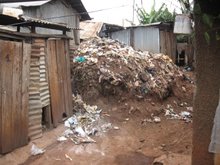
Kibera is heavily polluted by soot, dust, and other wastes. Open sewage routes, in addition to the common use of Flying toilets, also contribute to contamination of the slum with human and animal faeces. The combination of poor nutrition and lack of sanitation accounts for many illnesses. Not only are death by disease and conflict common inside this slum, but it is estimated that 1/5 of the 2.2 million Kenyans living with HIV live in Kibera.
Presently there are 40 million people infected with HIV/AIDS globally, with more being infected every day. HIV/AIDS is 100% lethal if left untreated. The UN estimates that 68 million people will die in sub-Saharan Africa because of AIDS in the next twenty years. That is:1.7 times more than the 40 million deaths in World War II, the most destructive war in human history.5 times more than the 13 million deaths in the previous two decades of the AIDS epidemic.307 times more than the 221,000 deaths in the Asian tsunami disaster of 2004.Other Statistics:In 1990 there were 7 million people infected with HIV/AIDS in sub-Saharan Africa.In 2000 there were 25.3 million infected.96 percent of HIV infected persons live in developing nations where drug therapies are largely unaffordable.Presently there are approximately 15 million children orphaned by AIDS in sub-Saharan Africa. That number is expected to grow to 40 million in the next two decades.3 million people died of AIDS in 2000. 12.1 million children were orphaned.Every 5 minutes 3 people die of HIV/AIDS. That is over 850 deaths every day or 315,000 a year. With each death, at least one more orphan is usually left.Every minute 10 people are infected with HIV/AIDS, which equates to 600 new infections an hour, 15,000 a day.
Friends
EMC in ASSISI
Enquirer Article
I agreed to talk to the Enquirer in hopes that it might more widely advertise our search for a new principal. I appreciate the article but am embarrassed. Now it's official - I have to do something!Here it is.
Fun . . .
"Pulling out the chairbeneath your mindAnd watching you fall upon God -
There is nothing else for Hafiz to dothat is any fun in this world!"
-Shamsud-din Mohammed HafizMuslim Mystic (1320-89)
Ash Barker - Make Poverty Personal
"The idols of this age say you can buy meaning in life in a department store, while the real God weeps that creation has swallowed such delusions whole without chewing and longs for us to love our neighbour in need. The starving millions have no voice against the shrieks of temporal happiness those pursuing such items risk all for. Authentic loving of God and neighbour then is still the great need of the hour ."
Henri Nouwen
"People who pray stand receptive before the world. They no longer grab but caress, they no longer bite but kiss, they no longer examine but admire."
Merton Gets It Right
"My first human act is the recognition of how much I owe everybody else."
God of the seasons, Lover of the ages, Master of every moment: You who are beyond time yet within all time. We return to you what you have given to us — the moments, the minutes, the hours, the days, the weeks, the months, and the year of 2006. Time has been gracious to us again, and we thank you for freely giving us these human bodies, these events, and these relationships. We have lived another year and we have died another year, and now you are granting us the beginnings of another.
We now hand over to you the blessed year, 2006, with all that it gave us and all that it took from us, knowing that both are necessary, just like our breath. We trust you in both the givings and the takings, the inhalings and the exhalings. May every breath of 2007 be a breath of the Holy Spirit, joyfully received and joyfully returned, beginning with this one right now.
Amen
God Alone-New Year's Eve
Merton Speaks
"MY LORD GOD, I have no idea where I am going. I do not see the road ahead of me. I cannot know for certain where it will end. Nor do I really know myself, and the fact that I think that I am following your will does not mean that I am actually doing so. But I believe that the desire to please you does in fact please you. And I hope I have that desire in all that I am doing. I hope that I will never do anything apart from that desire. And I know that if I do this you will lead me by the right road though I may know nothing about it. Therefore will I trust you always though I may seem to be lost and in the shadow of death. I will not fear, for you are ever with me, and you will never leave me to face my perils alone."