I got back from the Safari last evening - what a perfect time we had! We left on Friday early in the morning from the Children's Home. I was picked up by the safari company, guide and cook. We stopped along the way to pick up George and headed for groceries, Tuskers, etc. Then it was the long drive to Maasai Mara. The roads, as expected, were terrible but the scenery pleasant enough. Soon we were in the land of the Maasai. Tall, red blanketed figures, herding cattle and goats - everywhere. We stopped a few places for gas and drinks and arrived at the campsite, right outside the Main Gate of the Mara. The campsite was difficult to get to - rough dirt roads, rocks and animals cattle etc.) in the way. We arrived at a permanent campsite - great tents, great guy to welcome us and we quickly unpacked the van and were prepared a terrific lunch. Then it was time to pop the top of the van and head out for the first of out Game Drives. I won't go into all of the animals we saw, check out the Flickr site for pics. But we saw a ton of animals and were happy to be in the Mara at sunset.
That evening we returned to the site and were prepared yet another hot meal buy our cook. Then it was off to bed and we quickly fell asleep - until - we heard the sounds that were described to us to be the lions, marking their territory. We also heard hyenas and buffalo throughout the night. George and I agreed to wake each other up if we heard interesting lion sounds. At about 2:30 a.m. we got up to walk to the bathroom, about 100 yards and were greated by a Maasai warrior who was guarding our tent, seated outside the door. He walked us, spear in hand, to the bathroom. He told us there were lions in the area. We had also heard about a buffalo attack the night before where two were injured. (Might write about that sometime). The next morning we had a great breakfast and headed out on a morning Game Drive. We were to be out all day and stopped for a packed lunch at about 1:00pm. See pics. After dinner that night, George organized a small campfire with the young Maasai, son of the owner of the land we were on. George was a great help in translating, making deals, getting us to special places and also talking with the Maasai at the campfire. I fed him questions about killing lions, initiation rites, the attacks from the animals the night before etc. At one point, the Maasai talked about the poison that is made and placed on the tips of their arrows. This is made from some vegetation, boiled and the arrows are dipped. The arrows would kill a man instantly, a lion in five minutes. Then he left us and returned with the arrows and bow. Having had a couple of Tuskers, I was worried about George or me pricking our fingers on the arrows and dying in the wilderness. George, on the other hand, played with the bow like a Christmas gift. Later, George and I purchased Maasai blankets, knives for slaughtering goats (this Christmas) etc. We wore the blankets the next days! George is able to pull off the Maasai look, although he is Kikuyu. I had a little more difficulty and I don't think the tourists were buying me as a warrior. See pics. Again that night, we heard the sounds of Africa into the night. I walked to the bathroom with the warrior a couple of times through the night. The blanket looked great on me. The next morning we took off before sunrise for our last Game Drive in the Mara. What a different look - so early in the morning. The animals were more animated and they often kill their prey very early. The lighting is unbelievable and the pics I took look like postcards. After a late breakfast, we took the long drive to Lake Nukuru.
We stopped along the way for a packed lunch and arrived at Nukuru very late in the afternoon. Nukuru is George's hometown. He grew up there and has many relatives there, his dad included. At the guest House, inside Lake Nukuru Park, George looked at a young girls working there. She looked at him. "George? Is that you?" It was George's cousin Monica. The guide dropped George and I off at a local establishment where I met his sister and brother-in-law. The next day we took off for a sunrise Game Drive around Lake Nukuru. The lake is known for thousands of flamingos, but also for lion, white and black rhinos and other large game. There are also tons of monkeys and baboons. After the Game Drive we headed for George's homeland. It was one of the great things about the safari, being able to meet his family, see where and how he grew up. The place was so simple, dirt floors, sheep, goats, cows and a beautiful view of the hills. More to come.
Tuesday, December 18, 2007
Thursday, December 13, 2007
I posted some pics on the FLICKR site:

Lots accomplished today. I took a matatu very early this morning to YaYa and had some breakfast and some time on the computers. I am making a concerted effort to eat some junk and try to gain back some of the 17 pounds I have lost. I don't realize the change until I get away from the Village and look in a mirror! I got my haircut the last time and was shocked at the face looking back at me in the mirror. I think it is because of the diet - not because of any ailment, I feel great. I also answered some mail, sent some postcards and confirmed my safari plans. It was a great day. Kilonzo called from the Village. He is in charge of electric issues and will install the solar panels on the Clinic. I was encouraged that he called, asking if he can meet me in Nairobi to purchase all of the supplies to do the job. The project is jointly funded by friends in the Rotary and by the Diocesan students who sent me money. I also got a call from George, my Kenyan friend who will go on safari with me. I am always afraid that plans will not work out and therefor was afraid he might get caught up at the Village. He called to say he was packing and would head for Nairobi tonight. We leave at 7:00 a.m. Friday.
At the risk of sounding corny - I just have to tell you that these days, I continue to smile a lot. Things at the Village are going well, I feel I have found my place (not able to describe it though) and I just feel lucky to be in Africa, have a great family and great friends. In writing my thank you cards today, I was struck with how good people are and how willing people are to support the projects here. People in Nyumbani are amazed at the generosity of people in the states and in particular, the people from my old school and IHM parish. The list of supporters grows and the circle widens daily. There are so many who have helped me, and therefore helped the children and adults of Nyumbani. The Rotary is one of those organizations that is unbelievably generous - not just to my projects but many, many others. Thank you!
Again - I smile.

Wednesday, December 12, 2007
Prayerlife in Africa
 Sadly, I have not been as faithful to my prayer life as I was at the beginning of this journey. It's not a bad thing - I am still pretty much in touch with "the flow" and feel a connectedness to God and God's creations,but just not the regiment I had initially. Hoping to get some of that back. But I have been thinking a lot about "God is not out there!" the wise saying by a monk from Gethsemane. I am able to see God's face more clearly these days, in the faces of the children in the Village. Also, there is something so deep in the eyes of the grandparents - I know that God is present. I read a "life story" given to me by one of the boys. I won't share the details but he has gone through some difficult times to say the least. But sprinkled in his writing are phrases like "and this is when I saw God's miracles on me" or "we hadn't eaten for three days and when we got water, I thanked my almighty God" or "I promised God that when I am older and have a job, I'll return and buy a fatty cow for the Village." Their faith is real, simple and deep. I make it all too complicated. They rely on God for everything from food to water to rain for the crops. I am afraid that there are so many times that I just don't seem to need God. Like everything else in my life,I figure I can do it. I can save myself. I have all that I need and so much more. Where is the place for God in my over-indulged life. That is where my desire to get small, to get simple
 has helped me. There are times in the Village when I have been scared, alone, sick and weak. There are times when I have been frustrated, hurt, angry and wondering what in the hell I am doing in Africa. It is at those times that I have allowed God to save me, to be my Father, to love me. Without those times of struggle and fear (the opposite of faith) I am not sure that God would be so real. The "together" man has no need of God.
Kid Nation
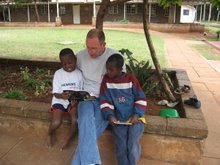
Three brothers - they look so rough and tough - but just the oppposite. I'll tell you their stories someday. Charles (Darwin) entering Grade 8; John entering grade 10; Benerd entering Grade 9. The only one missing from the picture is Lucy, their sister - also entering Grade 9. Click to enlarge.
I may have mentioned it before, but the Village sometimes reminds me of the show that was to air as I was leaving the states. The kids ran the place. The Village is sort of like that. Kids do almost everything in the Village. From the early morning hours, kids are working in the shambas, hoeing, weeding, watering. They cook, they do the laundry, they haul water and firewood, they open up the school building, they wash the floors of their houses. They have so much responsibility - it has been difficult to process it all. There is also a side of the children in the Village that is so real and touching, I will never forget it. The best times for me in the Village are between the hours of 4:30 and 6:30pm. The kids are home from school. The work in the fields has been completed and now the place is buzzing with laughter, singing, playing. I often walk from cluster (4 houses) to cluster. I can hear my name yelled across the Village - "Wambua" (my Kamba name meaning For the Rain) or they yell "Hed" or "Heddie" "Please come." They all invite you to the back of the house where you are given food and/or tea. You cannot refuse. No one will eat until you eat. They bring out their best chair for you to sit on and they sit on the dirt. Sometimes they ask you to come into their room and see their walls, covered with newspaper clippings of football stars, computer advertisements and even death notices "Musakta is Promoted to Glory". Sometimes the kids chase after you with a hot chapati, wrapped in a brown paper flour bag. Chapati is like nan or flat bread, cooked on a hot skillet. I went to tutor some of the kids one evening after dinner. The household was gathered around the table and the kerosene lamp. They brought me a plate heaped with scuma and ugali. You cannot refuse. The kids say exactly what they mean, exactly what they want. If they like your shoes, they don't say "Those are nice shoes. I wish I had a pair like them." Instead they say "Give me shoes." In the beginning,it was annoying. Now I just respond by saying "Give me your foot." They stopped asking. Charles "Darwin" (See pic above) and I have a routine on most nights. I say "Charles, what a beautiful sunset." Charles responds by whispering "but not as beautiful as you." I read the 7th grade a Fairy Tale. I ask Charles "Mirror,mirror on the wall, who is the most beautiful of all?" Charles whispers "White Snow".

NRB Again!
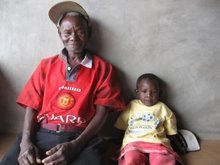
Pictured below is one of the two grandfathers. He carves many things. Here are some large spoons for stirring Ugali. Click to enlarge pictures. Here are two of the boys wanting to show off their sleeping room and a donated solar radio.
 Here are two of the boys wanting to show off their sleeping room and a donated solar radio.
I am back in Nairobi again. This time I am hoping to go on a short safari beginning Friday to Masai Mara and Lake Nukuru. I left the Village early this morning and,unlike the ride to the Village a week or so, the trip was much more pleasant and shorter. The last trip had many stops and we arrived after 11 hours. This time, I began at 7:30 a.m. with a 20 minute motorbike ride from the Village to the main road. It was beautiful,cool and quiet. I was able to appreciate the beautiful countryside, terraced farms and lots of animals - goats and cows. From KwaVonza, the little town where the paved road begins , I took a Matatu (death trap) van through Machakos to Nairobi. We carried 15 passengers, 30 live chickens and some un-named produce. We arrived in Nairobi by11:00 a.m. That was a record for me. From the National Stadium I took a bus to Karen and the Childrens Home. I am hoping to catch up on some writing and emails as well as get some good food and put on a few pounds. At my last visit, I found 203 emails waiting,mostly junk mail. This time I had 93. Thanks for writing. It helps.
Saturday, December 1, 2007
African Funeral
The student van was brought to the Village from the Children's Home in Karen. It was to be used for the two funerals. On Friday, yesterday, I was asked to accompany the family to the mortuary, retrieve Muki's body and take part, as much as I could, in the cultural burial rites. The van left to go the ancestral home where the grandmother was taken the day after the death. The van got stuck in the mud in the field, attempting to retrieve family members. Eventually the van was pulled from the mud using an old truck and "man" power. And so I rode with four family members, first to pick up the coffin in Kitui. We arrived, paid for it and loaded it into the back of the old van. Some seats were removed. The paint on the coffin was wet. We then proceeded, it was about 10:30 a.m. to the mortuary to get Muki. We had a shirt and a pair of trousers wrapped in an old newspaper. The gates to the government-run mortuary were locked. We waited. TIA. Finally we drove to the adjoining hospital to find someone to let us in. On our return and after more waiting, a "thug-like" kid unlocked the gate and let us drive through. The building was old, in need of paint and had almost a drive in window with a small price chart in the window for Mortuary Services. So many Kenyan shillings for embalming, so many shillings for each night there. One could look through the doors from the parking area and see Muki. The attendant was wearing a beer t-shirt and smoking a cigarette. We carried the wooded coffin inside and set it on the floor beside Muki. We took out the clothes which had been brought for dressing. Once completed, we carried Muki to the van and began a long ride to the home of his grandmother but not without some lengthy stops to pick up various items like a copy of the program, etc. We arrived at the home and were greeted by neighbors and grandmothers. About 60 students were gathered for singing etc. during the mass and they were also many of his classmates. The body was taken into a little one-room structure for the family to spend time. Woman came around to wash our hands and we were served ugali, chicken gizzards, rice. One doesn't refuse food at funerals. Once the lengthy mass was completed outside, the coffin was taken about 30 yards and buried next to his mother.
Bonfires
From sunset to about 9:30, for five nights after the deaths of the boys, bonfires were set - one outside each boy's house. All the neighboring residents joined for singing, dancing, prayers and stories. The children gathered the wood and for the most part, the older boys acted to organize the evenings. The girls lead song after song. The grandmothers were seated on the ground around the fires as well. It was somber, respectful but also had a mix of laughter and fun. Plastic Halloween mask and squirts guns appeared each night! Often the young ones would fall asleep in my arms as the night progressed. I held Wambua on a couple nights, Muki's young brother. On the last night, the night before the first burial, Sr. Mary came from Nairobi and spoke to the groups. It was wonderful to see her and hear her. She is very well respected and added some order and calm to the evenings. After 5 nights of bonfires, we were ready to let go, ready to bury the boys and it was going to be all right.
So my thoughts on life and death? My friend Richard wrote that there are some significant truths that young ones (specifically young men) need to know. In many cultures, these truths are incorporated into initiation rites, etc. Two of the truths I know I have tried to avoid, tried to keep from my students, probably tried to keep from my own children and myself. Life is hard. It is, and I want to make things easy for anyone and everyone. But I think I do them a disservice by trying to do things for them and I make them think that life is not hard - but it is. And the second truth - You are going to die! Damn it - we want to avoid that. We can cover it up, hide death, sanitize and suppress it. But we are going the die - sooner or later. For the two boys, it was sooner. The funeral, my visit to the mortuary (which was quite an experience I'll share later) the cold facts of the death and burial - I wanted to keep from the kids. But they/I need to realize the great truth - I will die. My faith says I will die but to a life that will not end. Either I believe that truth - or I can't believe any of it. These days, this week, I came to know death as real, harsh, even brutal, holy. But I can say that I have come to accept it and not fear it quite so much. It is one of those experiences for which I will be forever grateful.
So my thoughts on life and death? My friend Richard wrote that there are some significant truths that young ones (specifically young men) need to know. In many cultures, these truths are incorporated into initiation rites, etc. Two of the truths I know I have tried to avoid, tried to keep from my students, probably tried to keep from my own children and myself. Life is hard. It is, and I want to make things easy for anyone and everyone. But I think I do them a disservice by trying to do things for them and I make them think that life is not hard - but it is. And the second truth - You are going to die! Damn it - we want to avoid that. We can cover it up, hide death, sanitize and suppress it. But we are going the die - sooner or later. For the two boys, it was sooner. The funeral, my visit to the mortuary (which was quite an experience I'll share later) the cold facts of the death and burial - I wanted to keep from the kids. But they/I need to realize the great truth - I will die. My faith says I will die but to a life that will not end. Either I believe that truth - or I can't believe any of it. These days, this week, I came to know death as real, harsh, even brutal, holy. But I can say that I have come to accept it and not fear it quite so much. It is one of those experiences for which I will be forever grateful.


Life is Hard. You will die.
On Thanksgiving Day were were excited about the purchase of 30 jembes (hoes with axe handles) and 8 machetes. That afternoon, word spread that there were tools for working in the small household shambas (farms) and the day was filled with planting! I text friends to tell them how the Village had become alive after the first rains. Everyone planted, young, old, girls and boys. The place was unmistakably more active. The tools were purchased with some money from friends at IHM, my old school in Kentucky. The activity turned to fear as word spread that some boys had walked to the sand dam, newly filled with water from the rains. They went swimming. Rumor had it that one boy got stuck in the silt and sand, another went in to save him and both were trapped. "Bring torches, ropes and come!" I grabbed my boots, flashlights and some sweatshirts, for I knew they would be cold when freed from the water. I raced with Zac, a Kenyan volunteer, to the large shamba to the water. We passed crying children and grandmothers who had obviously been told to return home. They were to count their children in the households. There was talk that two drowned but they weren't sure if that was all. George and Steve met us to say that two boys could not be saved and their bodies remained. They had been submerged for over an hour. The police had been called and it was now a recovery effort, and it may be started again at daylight. It was too dark to see the water, let along see deep below. Some waited at the dam, I headed to the children in the household clusters. I walked through the village and at each washing center, in the middle of the four-house clusters, children sat, quiet. "Did you hear Eddie? Our dear friends . . . " "Eddie, I am not feeling very much OK. " The kids were in disbelief and they were alone in their questioning and despair. It was Mutisia and Mutombuki (Muki) two boys from the 6th and 7th GRade. Both great boys, athletic, one a goalie for the football team. All of the Village's grandmothers went to console the two grieving grandmothers. One was Monica, nearly 100 years old, though no one knows for sure.
And here is where my discomfort begins. Stay with me as I journey into my own feelings of life and death.
I was unfamiliar with the African culture when it comes to grieving and death. It is a strong Kamba tradition at the Village in Kitui. After the news spread, I was amazed to see children who lived in one of the two houses of the boys, out finishing washing their school clothes for the next day! Even Wmbua, little brother to Muki, was outside - not understanding what was going on. There are no adults to explain, comfort, communicate. I walked round and round the Village - just asking - "Are you ok? After about ten in the evening I went back tot he Guesthouse, my house and met some of the other staff and volunteers. It was late. They were exhausted but they found it difficult to go home. They talked about the sad recovery - two thin, naked boys, covered in mud. I was uncomfortable, not wanting to know more or discuss it. They talked and I listened to Kenyans talking about their own childhood experiences of death and tragedies at young ages.
The next morning, I left the house determined to be the first adult the children would see at school. You need to understand that on a normal day, the children begin arriving around 6:45 carrying firewood for the day. There are usually no teachers until around 8:00, while students wait for a student leader with keys and begin to wash the rooms and prepare the school for the day. Today was no different. The students were quiet and reserved. At around 8:00 a student rang a bell and they began their own assembly, a time where they usually sing, raise the flag and say a prayer. A young girl handed me an English Bible and asked me to read for the school. We stood outside around the flag pole in classroom order, in lines with smallest in the front, older students in the back. I spoke to them as much as my language skills permitted, told them not to be afraid and about a world that was without end. I told them we prayed with the two boys and with their parents who had died. We said the Our Father and I read from the Psalms, "The Lord is my shepherd . . . " The teachers arrived but did not address the students at all. They did not enter the classrooms all day. They went to the staff room and began grading the student end of year exams. Mariah and I spent the day going back and forth between the 6th and 7th Grade classrooms, quietly being present and available. At around 10:00 a.m. Sr. Mary came from Karen (Nairobi) and went to each class, talking openly about their death, what the children remembered about them, where they sat. She did the normal things I would have done in a school of children who were afraid and did not know what was happening. I asked one of the teachers what I should do when the older boys were crying uncontrollably. "You must act as if they are not crying. If you console them, others will join and they will not stop." Some of these boys were at the water when the boys died. Some were feeling tremendous sadness and guilt. Cold, hard, what seemed like repression of emotions. They have done it probably since the death of their parents. As I was told, the Village brought these children from a painful life to a place of peace and joy and safety. These deaths have introduced pain, once again, into their lives.
As you move back through these entries, you may understand how I have come to be "ok" and at peace with the harshness of how these deaths were handled. I so wanted to save the children from the pain, from the truth that LIFE IS HARD. YOU WILL DIE. (More to come.)
And here is where my discomfort begins. Stay with me as I journey into my own feelings of life and death.
I was unfamiliar with the African culture when it comes to grieving and death. It is a strong Kamba tradition at the Village in Kitui. After the news spread, I was amazed to see children who lived in one of the two houses of the boys, out finishing washing their school clothes for the next day! Even Wmbua, little brother to Muki, was outside - not understanding what was going on. There are no adults to explain, comfort, communicate. I walked round and round the Village - just asking - "Are you ok? After about ten in the evening I went back tot he Guesthouse, my house and met some of the other staff and volunteers. It was late. They were exhausted but they found it difficult to go home. They talked about the sad recovery - two thin, naked boys, covered in mud. I was uncomfortable, not wanting to know more or discuss it. They talked and I listened to Kenyans talking about their own childhood experiences of death and tragedies at young ages.
The next morning, I left the house determined to be the first adult the children would see at school. You need to understand that on a normal day, the children begin arriving around 6:45 carrying firewood for the day. There are usually no teachers until around 8:00, while students wait for a student leader with keys and begin to wash the rooms and prepare the school for the day. Today was no different. The students were quiet and reserved. At around 8:00 a student rang a bell and they began their own assembly, a time where they usually sing, raise the flag and say a prayer. A young girl handed me an English Bible and asked me to read for the school. We stood outside around the flag pole in classroom order, in lines with smallest in the front, older students in the back. I spoke to them as much as my language skills permitted, told them not to be afraid and about a world that was without end. I told them we prayed with the two boys and with their parents who had died. We said the Our Father and I read from the Psalms, "The Lord is my shepherd . . . " The teachers arrived but did not address the students at all. They did not enter the classrooms all day. They went to the staff room and began grading the student end of year exams. Mariah and I spent the day going back and forth between the 6th and 7th Grade classrooms, quietly being present and available. At around 10:00 a.m. Sr. Mary came from Karen (Nairobi) and went to each class, talking openly about their death, what the children remembered about them, where they sat. She did the normal things I would have done in a school of children who were afraid and did not know what was happening. I asked one of the teachers what I should do when the older boys were crying uncontrollably. "You must act as if they are not crying. If you console them, others will join and they will not stop." Some of these boys were at the water when the boys died. Some were feeling tremendous sadness and guilt. Cold, hard, what seemed like repression of emotions. They have done it probably since the death of their parents. As I was told, the Village brought these children from a painful life to a place of peace and joy and safety. These deaths have introduced pain, once again, into their lives.
As you move back through these entries, you may understand how I have come to be "ok" and at peace with the harshness of how these deaths were handled. I so wanted to save the children from the pain, from the truth that LIFE IS HARD. YOU WILL DIE. (More to come.)
CHECK OUT PICS AND MICHAELS BLOG
http://mjinafrica.blogspot.com/2007/11/village.html
A journalist and photographer from the states came and visited Kenya. They spent some time at the village and Michael took some amazing pictures. Above is Michael's blog address and Jennifer's is contained somewhere in his.
A journalist and photographer from the states came and visited Kenya. They spent some time at the village and Michael took some amazing pictures. Above is Michael's blog address and Jennifer's is contained somewhere in his.
Subscribe to:
Posts (Atom)